
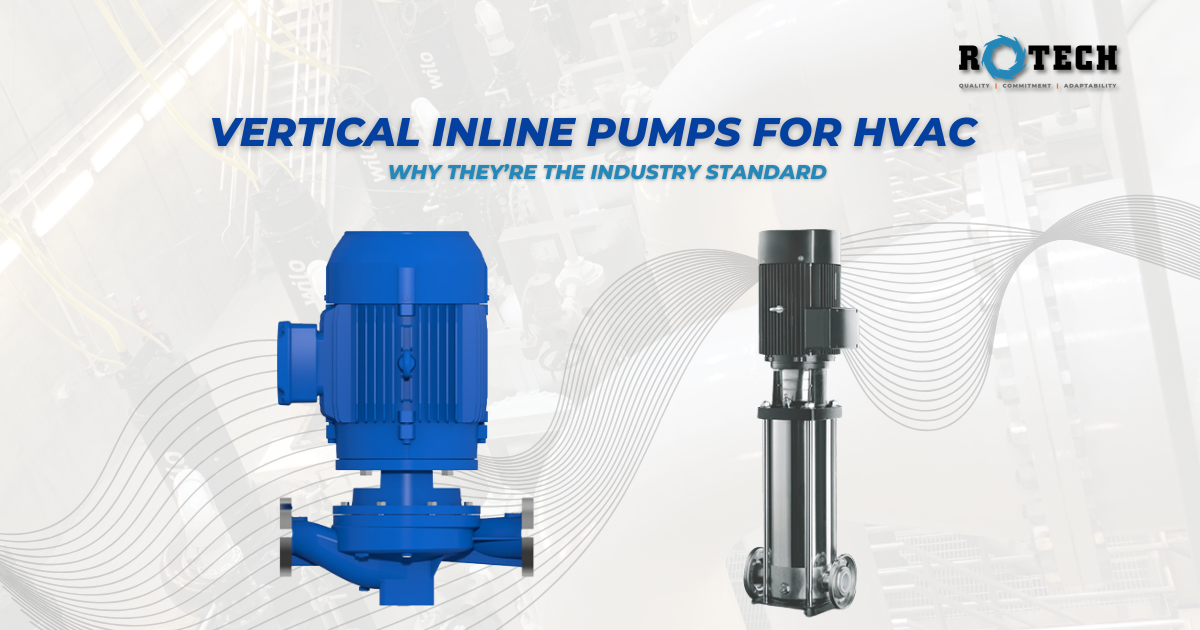
Walk into the mechanical room of almost any modern commercial building – a hospital, a hotel, a high-rise office tower – and you will almost certainly find vertical inline pumps doing the heavy lifting in the HVAC system. They sit directly in the pipeline, take up minimal floor space, and deliver reliable performance year after year with very little maintenance. That combination is exactly why mechanical engineers have made them their default choice for secondary chilled water loops, hot water distribution, and condenser water circuits across countless projects.
This article explains what vertical inline pumps are, how they work, why they are so well suited to HVAC applications, and what you need to consider when selecting and installing one. If you are an engineer specifying a new system, a facilities manager evaluating a replacement, or a contractor trying to understand what pump type your drawings are calling for, this guide covers what you need to know.
What Is a Vertical Inline Pump?
A vertical inline pump is a centrifugal pump where the suction and discharge ports sit on the same pipe centerline, and the motor is mounted vertically above the pump casing. Because the inlet and outlet share the same axis, the pump installs directly into a straight run of pipe – no separate base frame, no offset piping, no floor mounting pad required.
This in-line configuration sets it apart from a standard end suction pump, which has its suction entering axially at the front and discharge exiting radially at the top or side, requiring a base frame and more floor area. The vertical inline design trades that footprint for something much more compact and self-contained.
Inside the casing, the pump works like any other centrifugal pump. The motor drives an impeller at speed. The impeller imparts velocity to the fluid, and the volute casing converts that velocity into pressure. The fluid enters the pump from one side of the pipeline and exits from the other, with a meaningful increase in pressure – enough to overcome the friction losses and equipment resistance in the circuit it serves.
For a broader look at how centrifugal pumps operate, our guide on what is a centrifugal pump covers the fundamentals clearly.
How a Vertical Inline Pump Differs From Other HVAC Pump Types
Engineers working in HVAC regularly choose between three main centrifugal pump configurations. Understanding where each fits helps you make the right call for your project.
Feature | Vertical Inline Pump | End Suction Pump | Split Case Pump |
Floor footprint | Very small – in-pipe mounting | Moderate – base frame needed | Large – split casing and base frame |
Piping layout | Suction and discharge in-line | Suction axial, discharge radial | Suction both sides, discharge radial |
Access for maintenance | Motor removable without disturbing pipe | Casing accessible with pipe disconnect | Full casing splits for complete access |
Best flow range | Low to medium (up to ~2,000 GPM) | Low to high (up to ~5,000 GPM) | High (500 to 10,000+ GPM) |
Typical HVAC use | Secondary loops, fan coil circuits | Primary loops, general distribution | Primary loops in large central plants |
Vibration transmission | Low – motor weight dampens vibration | Moderate | Low |
The comparison with end suction pumps is worth looking at in more detail, and our article on end suction pumps vs inline pumps walks through the practical tradeoffs engineers face when choosing between the two.
Why Vertical Inline Pumps Became the HVAC Industry Standard
The dominance of vertical inline pumps in commercial HVAC did not happen by accident. Several specific advantages align directly with the constraints and priorities of HVAC system design.
Space Is Always at a Premium
Mechanical rooms in commercial buildings are expensive real estate. Building owners want them as small as possible, and architects push for every square foot they can recover. An end suction pump needs a base frame, anchor bolts, and room to walk around it for maintenance. A vertical inline pump hangs in the pipe. When you are fitting multiple pumps – primary, secondary, tertiary, dedicated fan coil pumps – that space difference adds up fast.
The Pipe Supports the Pump
Because the vertical inline pump is mounted directly in the pipeline, the pipe itself supports the pump weight. On larger models, supplementary floor stands or pipe hangers carry the load. This eliminates the need for a concrete inertia base or vibration isolation pad that would be standard practice with a base-mounted end suction pump. That simplifies installation and reduces cost.
Low Vibration Transmission
The vertical motor orientation creates a natural balance. The motor weight sits centered above the pump, and the vertical shaft reduces radial loading on the bearings compared to a horizontal pump handling the same flow. The result is lower vibration transmitted into the building structure – an important factor in occupied buildings where mechanical noise is a complaint risk.
No Alignment Required at Commissioning
With a base-mounted horizontal pump, coupling alignment between the pump and motor is a critical commissioning step. Get it wrong and you face early bearing and seal failure. Vertical inline pumps use a close-coupled design on smaller models, or a rigid coupling with factory-set alignment on larger ones. Either way, field alignment work is minimal or eliminated, which saves commissioning time and reduces the risk of human error.
Motor Replacement Is Straightforward
When a motor fails on a vertical inline pump, you unbolt it from the top of the pump casing and lift it clear. The pump casing stays in the pipe. The system can be isolated at the flanges, the motor swapped, and the pump returned to service without touching the piping at all. That kind of field serviceability matters to facilities teams responsible for maintaining building uptime.
Where Vertical Inline Pumps Are Used in HVAC Systems
Vertical inline pumps appear in HVAC at several points in the system, each with slightly different requirements.
Secondary Chilled Water Loops
In a primary-secondary chilled water system, the secondary loop pumps distribute cold water from the common header to air handling units across the building. Flow requirements vary constantly as occupancy and outdoor conditions change throughout the day. Vertical inline pumps paired with variable speed drives (VSDs) handle this load variation efficiently, reducing speed when demand drops and cutting energy consumption significantly in the process.
According to the U.S. Department of Energy, variable speed pumping systems can reduce pump energy use by 30 to 50% compared to fixed-speed operation in variable-flow applications – exactly the scenario of a secondary chilled water loop in a commercial building.
Hot Water Heating Distribution
Low-temperature hot water (LTHW) systems circulate water at 140 to 180°F through pipework to fan coil units, radiators, and radiant panels throughout a building. Vertical inline pumps are routinely used here because they fit neatly into the distribution riser and branch piping without requiring mechanical room space. Their compact form factor allows them to be installed in riser shafts or in ceiling voids where a base-mounted pump would simply not fit.
Materials selection matters in hot water service. Cast iron casings handle standard LTHW temperatures without issue, but seals and O-rings must be rated for the operating temperature. Always verify the mechanical seal’s temperature range against your system’s operating conditions.
Condenser Water Circuits
Condenser water systems circulate water between the chiller’s condenser and the cooling tower. The operating temperature is typically 85 to 95°F, and the flow rate is roughly 3 GPM per ton of refrigeration for standard chiller designs. These systems often run at constant speed for extended periods, which makes operating point selection especially important – you want the pump running near its best efficiency point (BEP) the majority of the time.
Fan Coil Unit Circuits
In buildings with many individual fan coil units – hotels, apartment buildings, hospitals – a dedicated pump circuit often serves each zone or riser. Vertical inline pumps are ideal here because they are compact, available in small flow sizes, and easy to install directly in the zone loop piping.
Domestic Hot Water Recirculation
While not an HVAC duty in the strict sense, domestic hot water recirculation systems use the same pump technology. Small vertical inline pumps keep hot water circulating through the domestic hot water loop so that occupants get hot water at the tap immediately without waiting for it to arrive from a distant heater.
Key Specifications to Understand When Selecting a Vertical Inline Pump for HVAC
Getting the selection right means working through a defined set of parameters. Skipping any of them leads to either undersized pumps that cannot meet system demand or oversized pumps that waste energy and wear prematurely.
Flow Rate (GPM)
Flow rate is the volume of water the pump must move per unit time. In HVAC, calculate it from the system’s peak cooling or heating load:
GPM = (Tons of cooling × 24) ÷ Temperature difference (°F)
For a standard chilled water system with a 10°F temperature differential, a 100-ton system requires 240 GPM. Add 10 to 15% for a realistic safety margin – but avoid excessive padding, which pushes the pump off its efficient operating range.
Total Dynamic Head (TDH)
Head is the total pressure the pump must overcome, expressed in feet of water column. It includes friction losses in the pipe, pressure drops across coils and heat exchangers, valve resistance, and any static elevation difference. Calculate it carefully using pipe sizing tables or hydraulic software. Underestimating head leaves you with low flow. Overestimating it results in an oversized pump running away from its BEP.
Pump Curve and Best Efficiency Point
Every centrifugal pump has a performance curve showing how head varies with flow at a given speed. The system has a corresponding curve showing how required pressure increases with flow. The pump’s operating point is where the two curves intersect. For efficient, reliable operation, this intersection should fall at 80 to 110% of the pump’s best efficiency point.
Our article on pump curves for centrifugal pumps gives you a practical breakdown of how to read and use these curves correctly.
NPSH Margin
Net Positive Suction Head (NPSHa) must exceed the pump’s required NPSH (NPSHr) by a safe margin – typically at least 2 to 3 feet. In most HVAC installations, vertical inline pumps are installed in flooded suction conditions, which generally provides adequate NPSHa. But always verify this in systems where the pump inlet is elevated or the suction piping is long and restrictive.
If you want to understand cavitation and how it damages pump internals, our article on how to prevent cavitation in centrifugal pumps is worth reading before finalizing your selection.
Motor Efficiency Class
In commercial HVAC, specify NEMA Premium Efficiency or IEC IE3 motors as a minimum. The motor is running thousands of hours per year, and a higher-efficiency motor pays back its cost difference quickly. When pairing with a VSD, also confirm the motor is inverter-rated to avoid insulation degradation from variable frequency operation.
Temperature and Pressure Ratings
Standard HVAC vertical inline pumps handle temperatures from around 14°F to 250°F and working pressures up to 200 to 300 PSI depending on the model. Always verify your system’s operating limits – including water hammer and surge conditions – fall within the pump’s rated envelope.
Materials of Construction
For standard treated chilled or hot water, cast iron casings with bronze or stainless steel impellers cover most HVAC applications. If your water treatment chemistry is aggressive, or if you have stainless steel piping requirements in the system, specify accordingly.
Variable Speed Drives and Vertical Inline Pumps: A Natural Pairing
The combination of vertical inline pumps and variable speed drives is now standard practice in commercial HVAC, and for good reason. The affinity laws govern centrifugal pump behavior, and the relationship between speed and power is powerful:
- Reducing pump speed by 20% reduces flow by 20%
- The same 20% speed reduction cuts power consumption by nearly 49%
That is not a linear relationship – it is cubic. Small speed reductions produce large energy savings.
In a variable primary or secondary chilled water system, the building load drops constantly during shoulder seasons and overnight hours. VSDs allow the pump to respond to that drop in real time, modulating speed to maintain the required differential pressure across the loop while consuming only the power the system actually needs.
ASHRAE Standard 90.1, which sets the baseline energy code for commercial buildings in the United States, mandates VSD control on chilled water pumps above 5 horsepower in variable-flow systems. Most new commercial projects are designed to this standard or beyond it.
For a broader look at efficiency strategies across pumping systems, our resource on efficient ways to increase the performance of pumping systems covers the full toolkit.
Installation Guidelines for Vertical Inline Pumps
Even a well-selected pump will underperform if installed poorly. These guidelines apply to most vertical inline pump installations.
Straight pipe at suction and discharge. Install at least 5 pipe diameters of straight pipe before the suction flange and 3 pipe diameters after the discharge flange. Elbows, tees, and other fittings close to the pump cause turbulent flow into the impeller, which reduces performance and increases noise.
Support the piping independently. The pump is designed to carry its own weight and the weight of the motor, not the piping. Excessive pipe loads on the flanges cause misalignment and accelerate seal and bearing wear. Pipe hangers and supports must carry the piping independently of the pump flanges.
Install isolation valves on both sides. Gate valves or butterfly valves on the suction and discharge sides allow the pump to be isolated for maintenance without draining the system. This is basic good practice that significantly reduces maintenance time and water damage risk.
Install a suction strainer. During commissioning especially, debris in the system can block or damage the impeller. A Y-strainer or basket strainer on the suction side protects the pump. Check and clean the strainer after the first few weeks of operation while the system is clearing construction debris.
Vent air from the casing before startup. Air in the pump casing prevents the impeller from generating pressure. Most vertical inline pumps have a vent plug or air release point – use it during initial fill and after any maintenance work that depressurizes the system.
Verify rotation before full-speed startup. Momentarily energize the motor and check that the rotation matches the arrow on the pump casing. Reverse rotation on a centrifugal pump produces low flow and pressure, and on some designs can damage the impeller or shaft seal.
For a detailed step-by-step reference on pump installation, our end suction pump installation and maintenance guide covers many of the same principles that apply to inline installations.
Maintenance Requirements for Vertical Inline Pumps
Vertical inline pumps are among the lowest-maintenance pump types in HVAC because of their simple construction. But low maintenance does not mean zero maintenance. Here is a practical schedule.
Weekly checks:
- Listen for changes in pump noise – new vibration or grinding sounds indicate bearing or impeller issues
- Check for seal leakage at the mechanical seal area
- Confirm motor amperage is within nameplate range
Monthly checks:
- Check motor bearing temperature – should be no more than 40°F above ambient
- Inspect suction strainer and clean if pressure differential has increased
- Check coupling condition on frame-mounted models
Annual service:
- Inspect and test mechanical seal – replace if weeping is evident
- Check impeller clearances against original specification
- Verify pump performance against original curve – efficiency losses of more than 5% suggest internal wear
- Inspect motor bearings and regrease if manufacturer schedule requires
The mechanical seal is the most common maintenance item on vertical inline pumps. In clean water HVAC service, seals typically last 3 to 5 years. Systems with glycol, aggressive water treatment, or temperature cycling toward the seal’s rated limit will see shorter service intervals.
For a comprehensive maintenance reference that applies to the centrifugal pump family broadly, our centrifugal pump maintenance checklist is a useful tool to keep on hand.
Common Problems With Vertical Inline Pumps in HVAC and How to Fix Them
Problem | Likely Causes | What to Do |
Low flow or pressure | Air lock in casing, partially closed valve, worn impeller | Vent the casing, check all valve positions, inspect impeller |
Mechanical seal leaking | Worn seal faces, incorrect seal for temperature/pressure, dry running | Replace seal; verify seal rating matches operating conditions |
Excessive vibration | Cavitation, bearing wear, pipe strain on flanges | Check NPSHa, inspect bearings, verify pipe supports are independent |
Motor overheating | Motor running overloaded, blocked cooling, VSD fault | Check operating amperage vs nameplate, inspect motor cooling fins, check VSD parameters |
Pump running but no flow | Reverse rotation, closed valve, air lock | Check rotation direction, open all valves, vent casing |
Short bearing life | Excessive pipe load on flanges, operation far from BEP | Install proper pipe supports, recheck pump selection against system curve |
Most of these problems are preventable with proper installation and sizing. Operating a pump far from its BEP – either far to the left or right on the curve – generates excessive radial thrust on the shaft and bearings, which is the most common root cause of premature mechanical failure in inline pumps.
Our guide on how to avoid common pumping mistakes covers this and other recurring errors in more detail.
Vertical Inline Pumps vs End Suction Pumps: When to Choose Each
This is the most common decision point engineers face when specifying HVAC pumps. Here is a direct comparison to guide the choice.
Choose a vertical inline pump when:
- Mechanical room space is tight and floor area is limited
- You need to install the pump in a riser shaft, ceiling void, or within the pipeline without a floor base
- Noise and vibration transmission into the building structure is a concern
- The application is a secondary distribution loop, fan coil circuit, or zone pump
- Flow requirements are under 1,500 to 2,000 GPM and head is moderate
Choose an end suction pump when:
- The installation has adequate floor space and a proper mechanical room
- You need a wider range of hydraulic options across a large flow range
- The application is a primary chiller loop or main distribution header
- You need easy access to the impeller and casing without pipe work
- Flow requirements exceed what inline designs handle efficiently
Neither pump type is universally better. They serve different installation constraints and hydraulic needs. Understanding both helps you make the right call for each specific application.
FAQ: Vertical Inline Pumps for HVAC
What is a vertical inline pump used for in HVAC?
Vertical inline pumps are used to circulate water through secondary chilled water loops, hot water heating distribution systems, condenser water circuits, fan coil unit branch loops, and domestic hot water recirculation systems. Their compact in-pipe design makes them the preferred choice whenever floor space is limited or the pump needs to be installed within the pipeline without a separate base frame.
What is the difference between a vertical inline pump and an end suction pump?
The main difference is physical layout and mounting. An end suction pump has its suction entering from the front and discharge exiting from the top or side. It requires a base frame and occupies meaningful floor space. A vertical inline pump has suction and discharge on the same pipe centerline, allowing it to mount directly into the pipeline. It takes up virtually no floor space. End suction pumps are generally used for larger primary loops, while inline pumps dominate secondary distribution and zone applications.
Can vertical inline pumps be used with variable speed drives?
Yes, and in most modern HVAC applications they should be. Variable speed drives allow the pump to reduce speed as system load drops, taking advantage of the cubic relationship between speed and power to produce significant energy savings. Most codes and standards, including ASHRAE 90.1, require VSD control on distribution pumps above 5 horsepower in variable-flow systems.
How long do vertical inline pumps last in HVAC systems?
With proper installation and regular maintenance, the pump casing and impeller of a vertical inline pump can last 20 years or more in clean water HVAC service. Mechanical seals typically last 3 to 5 years and are the most frequent maintenance item. Motors have a typical service life of 15 to 20 years depending on operating hours, thermal cycling, and quality of the original specification.
What causes a vertical inline pump to vibrate excessively?
Excessive vibration usually points to one of several issues: cavitation from insufficient NPSH at the inlet, bearing wear from extended operation, excessive pipe loads on the pump flanges from poorly supported piping, or operation far from the pump’s best efficiency point. Running a pump significantly below or above its BEP creates radial forces on the impeller that cause shaft deflection and vibration. Diagnosing which cause applies requires checking NPSH margins, inspecting bearings, verifying pipe support conditions, and reviewing the pump’s operating point against its performance curve.
What size vertical inline pump do I need for my HVAC system?
Sizing starts with calculating the required flow rate from your system’s peak load and target temperature differential, then calculating the total dynamic head by adding friction losses, equipment pressure drops, and elevation differences across the longest circuit. Plot those requirements against pump performance curves from shortlisted models and select the pump whose curve intersects your system curve at or near its best efficiency point. If you are not sure where to start, our guide on how to select the right pump walks through the full selection process.
Are vertical inline pumps self-priming?
Standard vertical inline pumps are not self-priming. They require the casing to be filled with liquid before startup. In HVAC applications this is normally not an issue because the system is pressurized and flooded before the pump is started. If your application requires a pump that can draw liquid from below its own elevation, a dedicated self-priming pump is the appropriate choice.
Can vertical inline pumps handle glycol solutions?
Yes, with some important considerations. Glycol increases fluid viscosity, which reduces the pump’s effective flow rate and head compared to water at the same speed. You need to apply a viscosity correction factor to the pump curve when sizing for glycol service. Glycol also affects the seal elastomers – verify the mechanical seal’s compatibility with the specific glycol type and concentration in your system before finalizing the selection.
Rotech RVI80 Series: A Vertical Inline Pump Built for HVAC Demands
When selecting a vertical inline pump for commercial HVAC, you need a product that delivers reliable hydraulic performance, is built from materials proven in water service, and is backed by a manufacturer that understands the demands of building mechanical systems.
The Rotech RVI80 Series vertical inline pump is engineered specifically for HVAC and building services applications. It covers the flow and head ranges typical of secondary chilled water loops, hot water heating circuits, and condenser water systems in commercial buildings. The design allows motor removal without disturbing the piping – reducing downtime during maintenance to a minimum. It is available in configurations compatible with standard VSD operation, making it straightforward to integrate into energy-efficient variable-flow system designs.
Rotech backs the RVI80 with application support to help you confirm the right model and size for your specific system, and with access to a full range of mechanical seals, couplings, and accessories for complete pump packages and replacement parts. For the full range of vertical centrifugal pump options, see the vertical centrifugal pump category.
Submit a pump inquiry with your flow rate, head, and operating temperature, and the Rotech team will confirm the right RVI80 configuration for your project. Or contact Rotech directly to discuss your application.
Recent Posts
Best Pump Materials for Sulfuric Acid: Alloy 20, Hastelloy C, and PVDF Compared
Choosing the wrong material for
HVAC Pumps: Complete Selection Guide for Chilled Water, Hot Water & Condenser Systems
HVAC pumps are the heart
Battery Acid Pumps: How to Select the Right Pump for Sulfuric Acid Transfer
Sulfuric acid is one of