
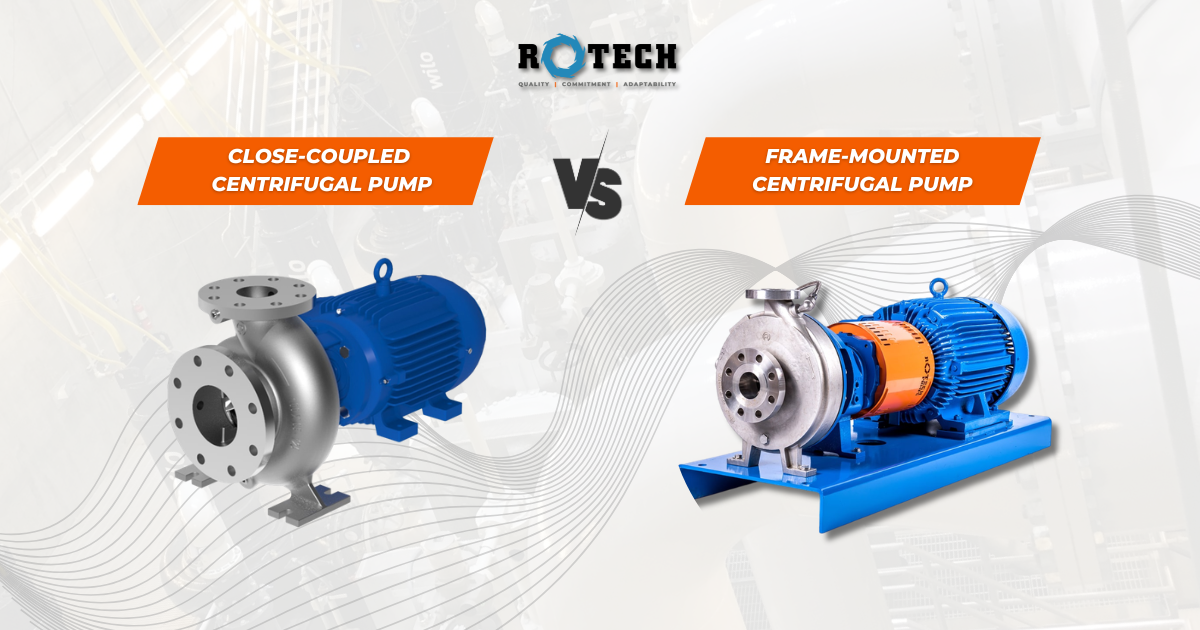
Choosing between a frame-mounted and a close-coupled centrifugal pump is one of the most common decisions in industrial pump selection. Both designs move fluid using centrifugal force, but they differ in how the motor and pump connect, how they handle maintenance, and where they perform best. The wrong choice can lead to frequent breakdowns, high maintenance costs, and poor system efficiency. This guide breaks down both pump types clearly so you can make a confident, informed decision.
What Is a Frame-Mounted Centrifugal Pump?
A frame-mounted centrifugal pump uses a separate base frame to support both the pump and the motor. A coupling and a coupling guard connect the two components to a rigid steel or cast-iron base frame.
The motor and pump are independent units. It means the pump shaft and the motor shaft are separate, connected by a flexible or rigid coupling.
This design is also known as a separately coupled pump or a base plate-mounted pump.
Key Components of a Frame-Mounted Pump
- Pump casing and impeller
- Pump shaft and bearings
- Mechanical seal or packing
- Flexible or rigid shaft coupling
- Coupling guard
- Base frame (common or separate base plates)
- Independently mounted motor
Heavy industrial processes, chemical plants, refineries, and water treatment facilities widely use frame-mounted pumps where reliability and long service life matter most.
What Is a Close-Coupled Centrifugal Pump?
A close-coupled centrifugal pump has its impeller mounted directly on the motor shaft. There is no separate shaft, no coupling, and no coupling guard. The motor and pump form a single, compact unit.
This design is also called a direct drive pump or a motor-mounted pump.
Key Components of a Close-Coupled Pump
- Pump casing
- Impeller mounted directly on the motor shaft
- Mechanical seal or packing
- Standard electric motor with extended shaft
- Single or dual support mounting bracket
Close-coupled pumps are popular in commercial buildings, HVAC systems, light industrial applications, and general water transfer where space is limited and budgets are tight.
Frame-Mounted vs Close-Coupled: Side-by-Side Comparison
| Feature | Frame-Mounted Pump | Close-Coupled Pump |
|---|---|---|
| Motor-Pump Connection | Separate shafts with a coupling | Impeller on motor shaft |
| Size and Footprint | Larger, needs more space | Compact, smaller footprint |
| Weight | Heavier | Lighter |
| Alignment Requirement | Yes, periodic alignment is needed | No alignment required |
| Maintenance Access | Easier, independent components | Slightly harder, motor involved |
| Motor Replacement | Easy, no pump disassembly | Motor replacement affects the pump |
| Vibration | Lower (flexible coupling absorbs it) | Higher risk of vibration transfer |
| Cost (Initial) | Higher | Lower |
| Cost (Long-Term) | Lower (easier maintenance) | Can be higher if the motor fails often |
| Ideal Application | Heavy-duty, high-flow, continuous | Light to medium duty, intermittent |
| Shaft Alignment Issues | Possible if misaligned | Not applicable |
| Bearing Life | Longer (separate bearings) | Shorter under heavy loads |
Key Differences Between Frame-Mounted and Close-Coupled Pumps
1. Mechanical Design and Construction
The biggest difference is how the motor connects to the pump.
In a frame-mounted pump, the pump has its own shaft supported by its own bearings. The motor shaft connects to the pump shaft through a coupling. It gives engineers the freedom to select the best motor for the job, independent of pump size.
In a close-coupled pump, the impeller sits directly on the motor’s extended shaft. The motor bearings also carry the hydraulic load of the pump. It simplifies the design but puts extra stress on the motor bearings.
2. Alignment and Installation
Frame-mounted pumps require precise shaft alignment during installation. Misalignment is a leading cause of bearing failure and seal leaks in centrifugal pumps. According to the Hydraulic Institute, shaft misalignment can reduce bearing life by up to 50%.
Close-coupled pumps eliminate alignment concerns. Because the impeller is fixed directly on the motor shaft, there is nothing to align. It saves installation time and removes one major source of maintenance headaches.
3. Maintenance and Serviceability
Frame-mounted pumps win here. When a mechanical seal fails or bearings wear out, you can service the pump without touching the motor. The two units are independent. It significantly reduces downtime and maintenance costs in plants that run pumps continuously.
With close-coupled pumps, any major pump repair often involves the motor as well. Replacing a seal or bearing means pulling the motor or at least accessing the motor shaft. It can increase labor time.
However, close-coupled pumps have fewer moving parts overall, which means fewer things can go wrong in the first place.
4. Motor Flexibility
Frame-mounted pumps allow you to use any motor that meets the power and speed requirements. You can upgrade the motor, switch from TEFC to explosion-proof, or replace it with a variable speed drive motor without changing the pump.
The motor design limits close-coupled pumps. The motor must have a standard extended shaft and the correct frame size for that pump model. Swapping the motor often means sourcing a specific replacement.
5. Vibration and Noise
Frame-mounted pumps with flexible couplings absorb vibration between the motor and pump. It leads to quieter operation and less wear on bearings and seals.
Close-coupled pumps transmit vibration directly from the pump to the motor. Under certain conditions, it can accelerate wear. Proper impeller balance is even more critical in close-coupled designs.
6. Cost Considerations
Close-coupled pumps cost less upfront. The compact, simplified design uses fewer parts and requires less manufacturing time. For lower-flow, intermittent-duty applications, it makes them a practical choice.
Frame-mounted pumps cost more initially. But over a 10 to 15-year service life in a demanding industrial setting, the lower maintenance costs and longer component life often make them more economical. A study by the U.S. Department of Energy found that pump maintenance and energy costs make up over 40% of total lifecycle costs, making initial price only one part of the decision.
When to Choose a Frame-Mounted Pump
Frame-mounted pumps are the right choice when:
- High flow rates and pressures are required. The robust bearing arrangement better handles hydraulic loads.
- Continuous 24/7 operation is needed. Independent bearings and seals last longer under constant running.
- Motor flexibility is important. You want the option to change motor size, type, or speed without replacing the whole pump unit.
- The pump handles hazardous or corrosive fluids. Easier access for seal maintenance reduces safety risks.
- The application involves high temperatures or special materials. Frame-mounted designs accommodate hot oil pumps, acid pumps, and ANSI process pumps more effectively.
- Vibration isolation is critical. Flexible couplings protect both the motor and pump from shock loads.
If you work in chemical processing, oil and gas, mining, or wastewater treatment, frame-mounted pumps are almost always the standard choice.
When to Choose a Close-Coupled Pump
Close-coupled pumps are the right choice when:
- Space is limited. The compact footprint fits tight mechanical rooms and skid-mounted systems.
- Lower initial cost matters. HVAC systems, irrigation, and commercial water supply often use close-coupled pumps for this reason.
- Intermittent duty cycles are involved. The pump does not run continuously, so bearing wear is less of a concern.
- Simple installation is a priority: no alignment, fewer connections, and quick commissioning.
- Standard water or light process fluids are involved. Low-viscosity, non-abrasive, ambient-temperature liquids are well-suited for close-coupled designs.
Inline pumps used in building services and HVAC systems are often close-coupled. Self-priming close-coupled pumps also work well for portable and semi-permanent installations.
Frame-Mounted Pumps: Pros and Cons
Pros
- Independent motor and pump servicing
- Better suited for high-flow, high-pressure duty
- Flexible motor selection
- Flexible coupling reduces vibration transfer
- Longer bearing and seal life in continuous service
- Easier to upgrade or modify over time
Cons
- Larger physical footprint
- Higher initial purchase cost
- Requires careful shaft alignment
- More complex installation process
- Heavier, harder to handle during maintenance
Close-Coupled Pumps: Pros and Cons
Pros
- Compact and lightweight
- Lower upfront cost
- No shaft alignment required
- Fewer components, less to go wrong
- Faster and simpler to install
- Easier to transport and relocate
Cons
- Motor bearings carry extra hydraulic load
- Motor and pump are not independently serviceable
- Limited motor flexibility
- Higher vibration risk under heavy loads
- Not ideal for continuous high-duty operation
- Replacing the motor requires more work
How to Select the Right Pump for Your Application
Pump selection is not just about frame type. It involves evaluating the whole system. Here are the core factors to consider:
1. Flow Rate and Head Requirements: Calculate your system’s required flow (GPM or m³/hr) and total dynamic head (TDH). High-flow, high-head systems benefit from frame-mounted designs with more robust bearing support.
2. Fluid Properties: Consider temperature, viscosity, corrosiveness, and whether the fluid carries solids. ANSI pumps and chemical process pumps are typically frame-mounted due to the demanding fluids they handle.
3. Duty Cycle: Is the pump running 24 hours a day or a few hours per week? Continuous duty strongly favors frame-mounted designs.
4. Installation Environment: Limited space? A close-coupled pump may be the only option. Large pump rooms or open plant floors? Frame-mounted pumps are easier to service.
5. Budget: Consider both capital cost and lifecycle cost. For a one-time installation with a 20-year horizon, lifecycle cost is more important than purchase price.
6. Maintenance Capability: Do you have trained maintenance staff on-site? Frame-mounted pumps require alignment skills and seal-replacement expertise. Close-coupled pumps are simpler for general maintenance teams.
For a deeper look at pump selection principles, read our guide to selecting the right pump.
Common Applications by Pump Type
Frame-Mounted Pump Applications
- Chemical processing plants (acids, solvents, aggressive fluids)
- Oil and gas refineries
- Hot oil systems and thermal fluid transfer
- Municipal water and wastewater treatment
- Mining and slurry handling
- Industrial cooling water circuits
- High-pressure boiler feed
Close-Coupled Pump Applications
- HVAC and building services
- General water supply and pressure boosting
- Irrigation systems
- Light chemical dosing
- Food and beverage processing (sanitary close-coupled models)
- Swimming pools and water features
- Portable and skid-mounted systems
What About ANSI Pumps?
ANSI pumps (American National Standards Institute) are a specific class of centrifugal pump built to dimensional standards defined by ANSI B73.1 (for frame-mounted) and ANSI B73.2 (for close-coupled).
ANSI B73.1 pumps are frame-mounted, horizontally oriented, end-suction pumps. They are the workhorses of the chemical process industry.
ANSI B73.2 pumps are close-coupled versions of the same standard. They share interchangeable parts with B73.1 pumps but eliminate the coupling and base frame.
The ANSI standard ensures that pumps from different manufacturers are dimensionally interchangeable. It makes replacement straightforward without re-piping.
Learn more about the differences between ANSI pumps and API pumps to understand where each standard applies.
Mechanical Seals: How Pump Type Affects Seal Selection
Mechanical seals are critical in both frame-mounted and close-coupled pumps. But the pump type affects seal selection in important ways.
In frame-mounted pumps, the seal only handles the pump fluid pressure and temperature. The motor dynamics are isolated. It enables a wider range of seal designs, including dual-cartridge seals for hazardous fluids.
In close-coupled pumps, the seal must also cope with any motor shaft movement. Single spring seals are common. The limited space in close-coupled housings can restrict seal options.
For a thorough look at maintaining pump seals and components, read our centrifugal pump maintenance checklist.
The Role of Impeller Design in Both Pump Types
The impeller transfers energy from the motor to the fluid. Both pump types use the same impeller styles: open, semi-open, and closed impellers.
However, the consequences of impeller imbalance differ:
- In a frame-mounted pump, the coupling absorbs some vibration from an imbalanced impeller before it reaches the motor.
- In a close-coupled pump, impeller imbalance transfers directly to the motor bearings, accelerating bearing wear.
That’s why close-coupled designs demand especially critical impeller balance. Learn about how impellers work in centrifugal pumps.
Split Case Pumps vs Frame-Mounted End-Suction Pumps
It is worth noting that frame-mounted pumps are not all the same. A horizontal split case pump is also frame-mounted, but it uses a different casing design that splits horizontally for easy impeller access.
End-suction frame-mounted pumps are the most common type in process industries. Split-case pumps are used more often in high-flow municipal water supply applications.
For a detailed comparison, read our post on end-suction pumps vs. split-case pumps.
Tips to Extend the Life of Your Centrifugal Pump
Whether you use a frame-mounted or close-coupled pump, these practices extend service life:
- Check alignment regularly (frame-mounted pumps). Even small misalignment causes bearing and seal damage over time.
- Monitor vibration levels. A sudden increase in vibration is an early warning sign of bearing wear or impeller damage.
- Inspect mechanical seals monthly. Seal leaks are the most common cause of pump failure.
- Maintain proper lubrication. Over-lubrication and under-lubrication both damage bearings.
- Avoid dry running. Running a centrifugal pump without fluid destroys the seal within minutes.
- Check suction conditions. Poor suction conditions cause cavitation, which rapidly erodes the impeller. Read our guide on how to prevent cavitation in centrifugal pumps.
- Review pump curves periodically. Operating too far from the best efficiency point (BEP) causes excessive wear. Understand centrifugal pump curves to keep your system running efficiently.
FAQ: Frame-Mounted vs Close-Coupled Centrifugal Pumps
What is the main difference between a frame-mounted and a close-coupled pump?
The main difference is how the motor and pump connect. A frame-mounted pump uses a separate coupling and base frame to connect a standalone motor to the pump. A close-coupled pump has the impeller mounted directly on the motor shaft, forming a single compact unit.
Which pump type is easier to maintain?
Frame-mounted pumps are generally easier to maintain because the motor and pump are independent components. You can service the pump without touching the motor, which reduces downtime and labor costs.
Can I replace a close-coupled pump with a frame-mounted pump?
Yes, in most cases. You will need to adjust the base mounting and piping and add a motor. The hydraulic performance (flow rate and head) will be the same if you select the same pump model in a frame-mounted configuration.
Are close-coupled pumps less reliable than frame-mounted pumps?
Not necessarily. For light- to medium-duty applications and intermittent operation, close-coupled pumps are highly reliable. For heavy industrial or continuous-duty applications, frame-mounted pumps generally offer longer service intervals and lower lifecycle costs.
Do frame-mounted pumps require more installation space?
Yes. The separate motor, coupling, and base frame take up more floor space than a close-coupled unit. If space is limited, close-coupled pumps are a practical alternative.
What types of fluids are best suited to frame-mounted pumps?
Frame-mounted pumps are better suited for hot, corrosive, high-pressure, or abrasive fluids. The robust bearing arrangement, wider seal selection, and mechanical isolation between motor and pump make them the preferred choice in chemical processing, hot oil transfer, and wastewater treatment.
Are ANSI pumps available in both frame-mounted and close-coupled configurations?
Yes. ANSI B73.1 covers frame-mounted end-suction pumps, and ANSI B73.2 covers close-coupled end-suction pumps. Both standards ensure dimensional interchangeability, making it easy to switch between configurations if needed.
How do I know if my pump is running at its best efficiency point?
Plot your operating point on the pump performance curve. The best efficiency point (BEP) is the point at which the pump achieves maximum hydraulic efficiency. Operating significantly away from BEP causes higher energy consumption, vibration, and wear. Use our guide on centrifugal pump flow rate to help with this calculation.
Final Thoughts
Choosing between a frame-mounted and a close-coupled centrifugal pump comes down to your specific operating conditions, maintenance resources, and long-term cost expectations. Close-coupled pumps offer compact, affordable, and simple solutions for lower-demand applications. Frame-mounted pumps deliver the durability, flexibility, and serviceability demanded by demanding industrial processes.
There is no single answer that fits every application. The best approach is to evaluate your flow requirements, fluid properties, duty cycle, and maintenance capabilities before making a final decision.
At Rotech Pumps, we stock a full range of both frame-mounted and close-coupled centrifugal pumps to suit every industrial need. From our DN Series Frame-Mounted Centrifugal Pumps to our DNJ Series Close-Coupled End Suction Pumps, our engineering team helps you select the right pump, seal, and configuration for your exact application. If you need help deciding, contact our team or submit a pump inquiry today.
Recent Posts
Best Pump Materials for Sulfuric Acid: Alloy 20, Hastelloy C, and PVDF Compared
Choosing the wrong material for
HVAC Pumps: Complete Selection Guide for Chilled Water, Hot Water & Condenser Systems
HVAC pumps are the heart
Battery Acid Pumps: How to Select the Right Pump for Sulfuric Acid Transfer
Sulfuric acid is one of